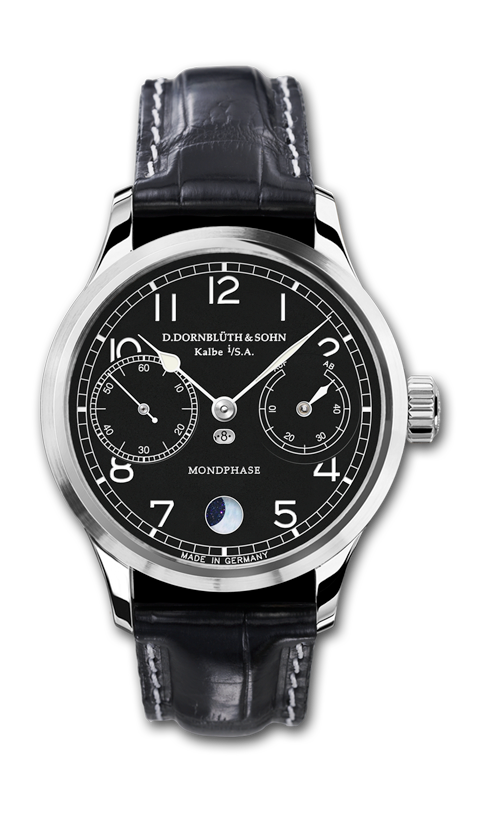
D. Dornblüth & Sohn
One of Germany's best-kept watchmaking secrets — a father-and-son atelier in the village of Kalbe, Saxony-Anhalt, in a modest two-story house with apple and plum trees, working with vintage and manual machines, far from any watchmaking centre. The story begins in 1959 when Dieter Dornblüth — then a young watchmaker from nearby Salzwedel — was given a near-hopeless repair case: a sterling silver pocket watch with an eccentric seconds display. He restored it, fell in love with it, and the same evening sketched out his own wristwatch movement inspired by it. Then life intervened: he was called to Kalbe to take over an abandoned watchmaking business, and the sketches disappeared into a drawer for 40 years.
On 1 October 1999 — Dieter's 60th birthday — his son Dirk, also now a master watchmaker, presented his father with a wristwatch he had made entirely himself, based on the Glashütte calibre 60.3. Dieter revealed the 40-year-old sketches. They founded D. Dornblüth & Sohn that same day. The first watch based on Dieter's original 1959 design, Model 99.2, was released in 2002. Around 80% of all components are made in their own workshop; the flagship Quintus collection uses 95% in-house parts. Three-quarter plates, screwed gold chatons, swan-neck spring regulators, Glashütte ribbing, blued screws — traditional German finishing throughout. Ceramic dials hand-milled and polished without CNC machines. Bespoke builds on request: dial, hands, movement, engraving. 120–150 pieces per year total. Often adorned with engravings by Jochen Benzinger of Baden-Baden.
The workshop's history since founding has been one of quiet, steady accretion. Demand forced a move to new premises in 2003 and a further expansion in 2005; in 2008 the atelier restored the marine chronometer of the sail training ship Gorch Fock I, marking the ship's 75th anniversary with a commemorative limited edition; and the original calibre 99.2 has grown into an entire 99-family of movements — from the essentials-only 99.0 to small-seconds, moon phase (the 99.6M of 2020), and centre-seconds variants — all wearing the same hand finishing. The most ambitious step came on 18 October 2024, when the team celebrated 25 years of in-house watchmaking (and 62 years of the Dornblüth name in Kalbe) by unveiling a flyback chronograph: 30-minute counter at 3 o'clock, an 'Auf und Ab' power-reserve display at 9, and — unusually — a permanently running centre seconds that also serves as the stop-seconds, in a movement developed from a 1997 patent, with rhodium-plated grained bridges and the company name hand-engraved and gilded on each example. The anniversary gathering itself said much about the brand: owners simply showed up wearing their Dornblüths, like a club meeting in a village orchard. Prices remain among the most honest in artisan watchmaking — pieces trade hands in the $7,000–12,000 range — and a devoted following in the United States, served by specialist retailers, has helped carry the name far beyond Saxony-Anhalt while production stays deliberately capped at what a small family workshop with vintage machines can finish by hand.