Korpela
Kaj Korpela was born in Sweden in 1982 and was drawn from childhood to manual, mechanical work — carpentry, and taking objects apart to rebuild them. That instinct led him, on his older brother's suggestion, to the Watchmaking School in Borensberg, Sweden, from 1999 to 2003, and from his very first day there he knew he had found his calling. With opportunities to develop further as a watchmaker limited at home, he moved to the Zurich area just three days after graduating to work for a small Swiss brand, then returned to formal training in 2005 through the WOSTEP Refresher course, which introduced him to complicated watchmaking more thoroughly during a subsequent post at Ulysse Nardin in Le Locle. The most formative posting of all, in Korpela's own account, was a year at Janvier S.A., the atelier of Vianney Halter: brief as it was, it exposed him to a high level of artistic watchmaking and to Halter's philosophy of working as self-sufficiently as possible — a mind-set that shaped Korpela's own path from that point on. In 2008, after only a year with Halter, he was offered the chance to set up his own atelier and took it, establishing Atelier Korpela in Bern, where he spent the following years producing components and timepieces for other Swiss brands while quietly researching the watchmaking approach he would eventually call his own.
That approach crystallised in 2015. As the Swiss watch industry entered what Korpela recognised as a coming downturn, he took a planned sabbatical of at least a year from his commercial work, beginning in August 2015, to build a watch entirely representative of himself as a craftsman. His two guiding references were his brother Henrik — a respected watchmaking teacher who founded the KHWCC academy in Le Locle and had already completed a similarly ambitious personal project — and the writings of the late George Daniels, whose books gave Korpela a working understanding of how a watch could be made almost entirely by hand. He has said that only in retrospect did he fully grasp what his brother, and later Philippe Dufour, had tried to warn him about: undertaking such a project means forgetting weekends, holidays, and any real time off. Rather than basing his movement on an existing calibre's dimensions or components, Korpela made the harder choice of designing every part from a blank page, with no reference to prior movements, so that the final result — and the fine-tuning of critical components like the escapement — would be entirely his own rather than adapted from parts designed for mass production. His stated ambition since has been to make watches that are 100% the product of a single watchmaker's hands, with every part besides jewels and springs machined from raw material using only traditional manual machines and hand tools.
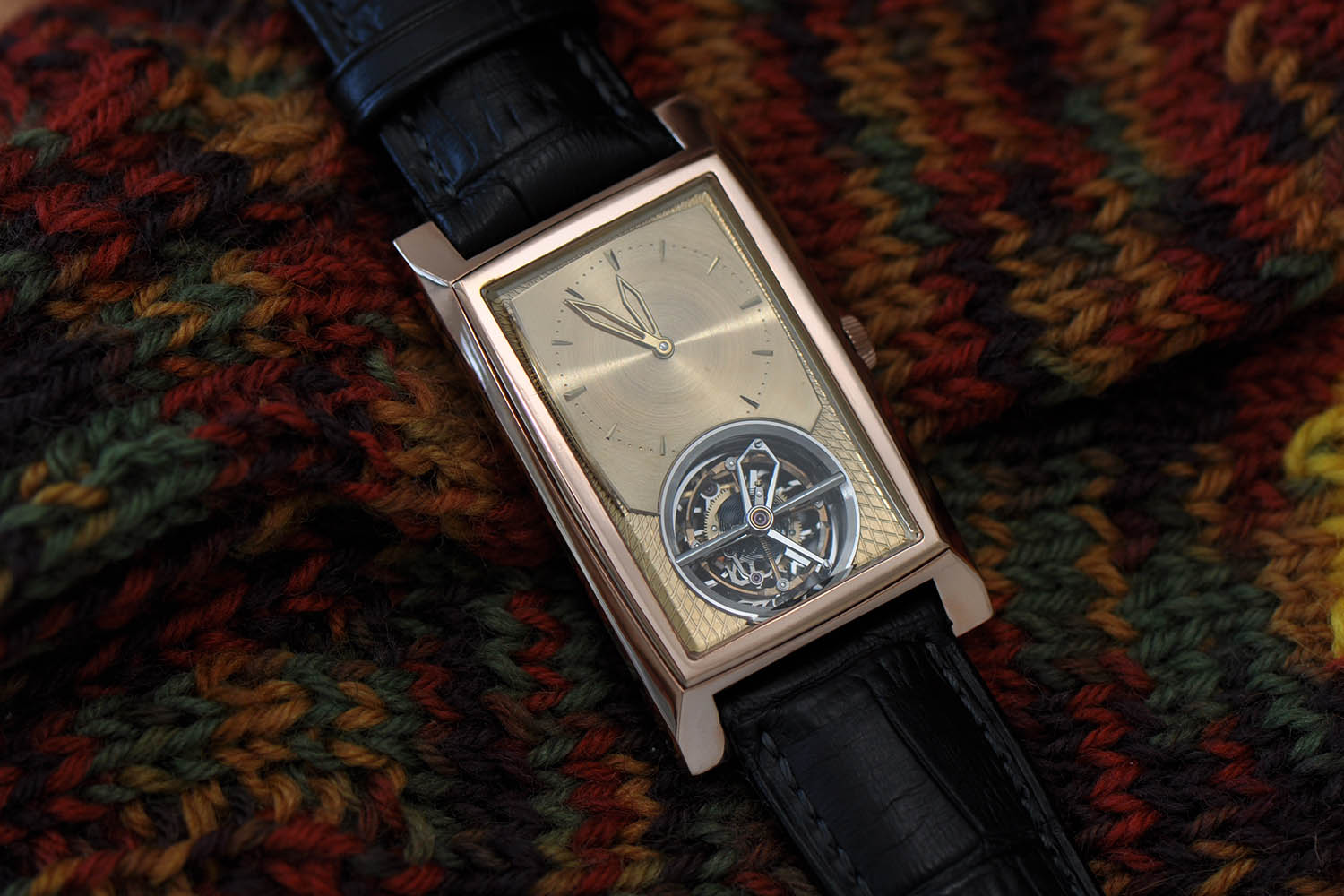
The result, Timepiece No. 1, took roughly 2,300 hours to complete — about a year's work — including a rough first-pass finish on the visible components. Rectangular with an Art Deco character recalling the Rolex Prince, the Patek Philippe Gondolo, and A. Lange & Söhne's Cabaret, the prototype case measures 43.4mm by 25.7mm and a slim 8.5mm thick, milled from brass and rose-gold plated, with steel, platinum, and other precious metals offered as customer options. Inside sits a hand-wound one-minute tourbillon: a free-sprung beryllium-copper balance regulated by four platinum inertia weights, paired with a Phillips terminal-curve hairspring, running at the traditional 3Hz (21,600vph) with roughly 60 hours of reserve. Every part of the movement besides the balance spring is machined and finished by Korpela himself — the organically shaped, skeletonised tourbillon bridge alone required around 100 hours of black-polishing and hand-angled bevelling — and the prototype's raw, untreated brass dial was left deliberately unfinished, a placeholder for future work exploring engine-turned guilloché and other dial treatments. Only five examples of Timepiece No. 1 were planned, each with a lifetime warranty, complimentary regular overhauls, and its own private ownership blog documenting its history; reviewers at the time situated the work squarely in the tradition of George Daniels, Roger Smith, and Philippe Dufour, calling it independent watchmaking and hand-made construction in their purest, least diluted form. No public updates on the atelier or further timepieces appear to have followed since, making Timepiece No. 1 — and the singular, self-taught rigour behind it — Korpela's defining statement to date.