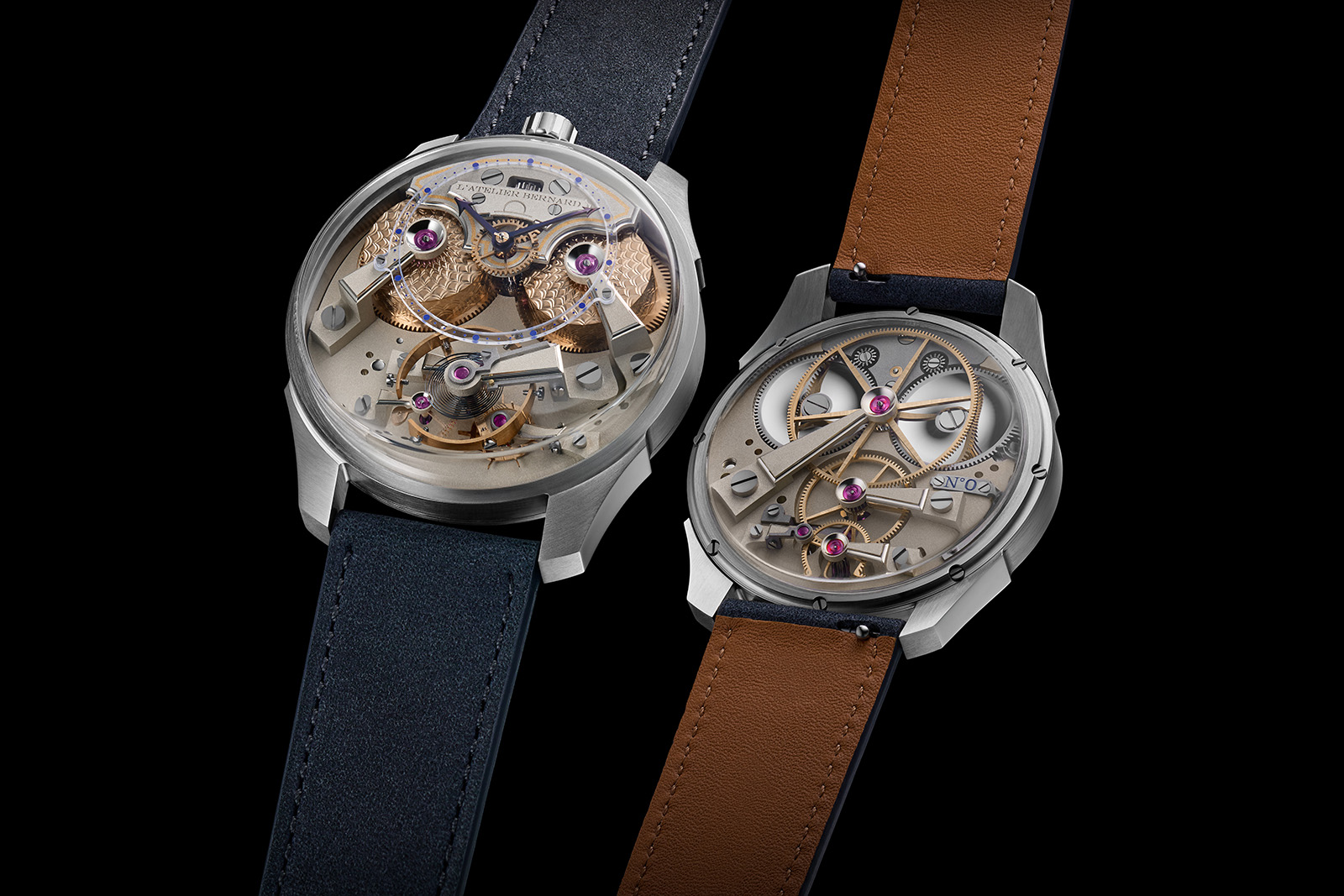
L'Atelier Bernard
Founded by two young Belgians — both named Bernard — working from an apartment-workshop in Fleurier, nestled between Vaucher Manufacture, Parmigiani Fleurier, and Kari Voutilainen's legendary atelier. Bernard van Ormelingen (27) trained at the Institut d'Art et de Technique in Namur, worked at Jaeger-LeCoultre, and previously produced guilloché dials for Van Bricht; he trained with a Belgian gold inlay artist and mastered the rare art of concave bevelling. Bernard Braboretz (26) is entirely self-taught, starting near the Spa-Francorchamps circuit.
Their philosophy: every watch developed and finished entirely by the two of them — from first sketches to final regulation — with no delegation to machines (only mainspring, hairspring, and jewels come from outside). Six pieces total, three per year across 2026 and 2027.
Their debut The Owl (39mm x 14.5mm Chronifer steel, CHF 150,000, all sold) features an in-house hand-wound movement with a duplex escapement — a frictional rest, deadbeat tangential impulse escapement invented in the early 18th century (attributed variously to Hooke, Dutertre, Le Roy, and Tyrer), abandoned in favour of the lever but revived here. The Owl's version uses tall pins rather than conventional impulse teeth; a counterweight geared to the balance prevents over-banking. The free-sprung balance beats at a slow 1.5Hz (10,800vph), with NOS Nivarox 2 hairspring and Breguet overcoil. Two hand-guilloché twin barrels dominate the dial like owl's eyes; the wavy rose-engine pattern wraps seamlessly from flat top to cylindrical drum. Gold inlay frames the bridge at 12 o'clock; concave chamfers — rarely seen in haute horlogerie — edge the bridges; flame-blued harpoon hands. Rate: ±3 seconds/day. A prototype has been running for three years.