Lederer
Bernhard Lederer is one of independent watchmaking's longest-serving and most quietly consequential figures — a German-born watchmaker who has spent over forty years pursuing a single philosophical objective: the perfect escapement. Born in 1958 in Kornwestheim, Baden-Württemberg, he discovered his calling in his teenage years when he stumbled upon technical books on escapements in a local library — and from that moment the escapement, the beating heart of every mechanical movement, became his life's obsession. In 1976 he began his formal training as an apprentice at the Wuppertal Clock & Watch Museum, learning centuries of tradition by restoring antique clocks and pocket watches, understanding not just how to repair them but how to understand them at the level of mechanical law. His earliest independent creations were primarily clocks; one notable early piece incorporated a gravity escapement so precise that it requires a calendar correction only once every 3,200 years — an indication of the scale of accuracy he was already pursuing. He moved to Switzerland in the early 1980s and later in 2000 settled in Neuchâtel, where he founded BLU Source du Temps SA (BLU: Bernhard Lederer Universe) and later the Lederer Manufacture. During those years he also worked as a movement construction consultant for multinational watch brands — a parallel career that remained largely invisible to the public but that funded and informed his private research.
He has been a member of the AHCI since 1985, making him one of its founding generation and one of its most senior active members. His early BLU watches were produced in very small numbers and stood out for their originality, often rethinking how time could be displayed rather than simply how it could be measured. He is also a member of the Fondation de la Haute Horlogerie and the Horological Society of New York; in 2025 he was invited to serve on the GPHG jury itself — a form of institutional recognition that acknowledged his technical standing among peers. He mentors apprentices and has spoken publicly about his desire to ensure that the art of high-precision escapement-making outlives him.
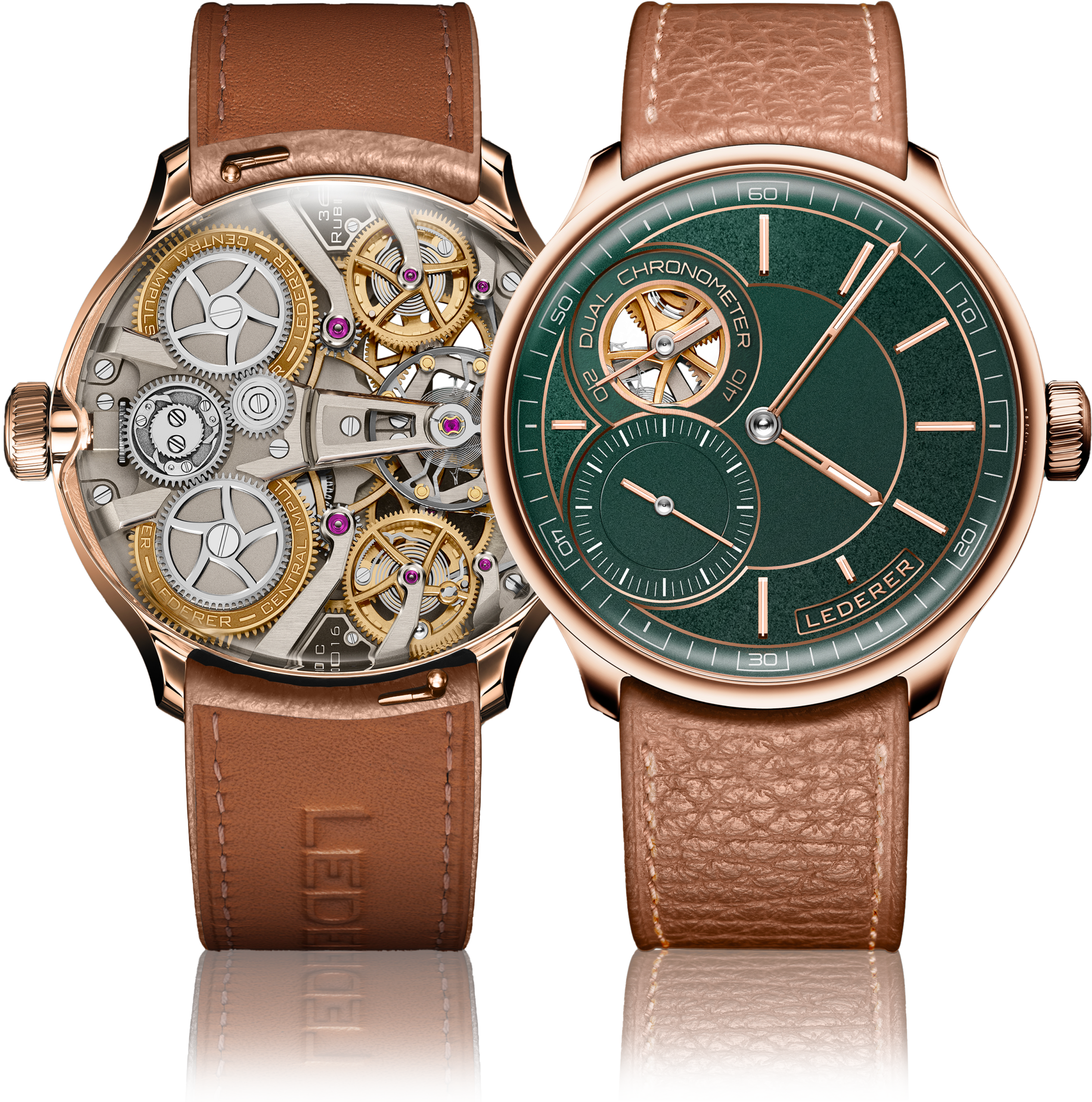
The Central Impulse Chronometer — CIC — is the watch that brought Lederer to the attention of the international collector community and stands as one of the most technically significant debuts in independent watchmaking of the 21st century. Unveiled in 2020 after over a decade of private research and refinement, the CIC is the direct heir to a line of escapement ambition that runs from Abraham-Louis Breguet to George Daniels to Bernhard Lederer. Breguet, in the early 19th century, conceived the natural escapement: a mechanism using two escape wheels to deliver direct impulse to the balance without sliding friction, reducing energy loss and improving chronometric performance. Manufacturing limitations of the era meant only a handful were ever realised. Two centuries later, George Daniels revived and resolved the concept with his Independent Double Wheel escapement — used in the Spacetraveller I and Spacetraveller II pocket watches — demonstrating that a single master watchmaker could still redefine the fundamentals of precision. Lederer's Central Impulse Chronometer advances the lineage further: two fully independent gear trains, each with its own barrel, drive two separate escape wheels in the Dual Detent architecture.
Between each gear train and the escapement sits a remontoir d'égalité — a constant-force mechanism that isochronously rewinds a small intermediate spring at precise intervals, delivering perfectly even torque to the escapement regardless of the varying tension in the mainspring as it unwinds. The result is an escapement that receives mechanically identical impulses at every beat — the closest any practical wristwatch has come to the theoretical ideal. The movement comprises 212 hand-finished components; all bridges, plates, and functional surfaces are decorated by hand with polishing, bevelling, and frosting; 98% of every component is produced in-house at the Neuchâtel manufacture, from dial and hands to the escapement itself. The CIC received the GPHG Innovation Prize in 2021 — recognised for its technical breakthrough and masterful reinterpretation of the Daniels principles. The CIC is offered in two case sizes: 39mm in 5N rose gold at CHF 155,000, and 44mm, both across multiple dial expressions (Deep Blue, Nordic Silver, Black Rhodium, Racing Green, Longitude Cobalt-Blue). The InVerto variant inverts the entire architecture so that the movement — twin gear trains, remontoirs, and dual escape wheels — faces outward on the dial side within a concave titanium case, transforming the mechanics into the visual centrepiece.
The Triple Certified Observatory Chronometer represents Lederer's next step: a scientific declaration that chronometric claims should be independently verified. The watch is the first in history to carry four official chronometry certifications simultaneously — from the Observatory of Geneva, the Glashütte Observatory in Germany, the Besançon Observatory in France, and the COSC. It won the GPHG Chronometry Prize in 2024, confirming both mechanical ingenuity and measurable real-world precision. It was produced in a series of 8 pieces. Lederer has stated publicly that his series of watches dedicated to the great 'Masters of Escapement' is a continuing programme — a structured exploration of the greatest escapement architectures in horological history, with each reference paying tribute to a different master while contributing Lederer's own engineering innovations. The Prototype 00 — Lederer's original research prototype — sold at the Phillips Geneva Watch Auction on 9 May 2026 for CHF 342,900, confirming the secondary market's estimation of where his work stands. Per-model quantities rarely exceed a dozen pieces; the waiting list is structured and unhurried. As Revolution Watch observed, those fortunate enough to acquire a Lederer watch are holding horological history.