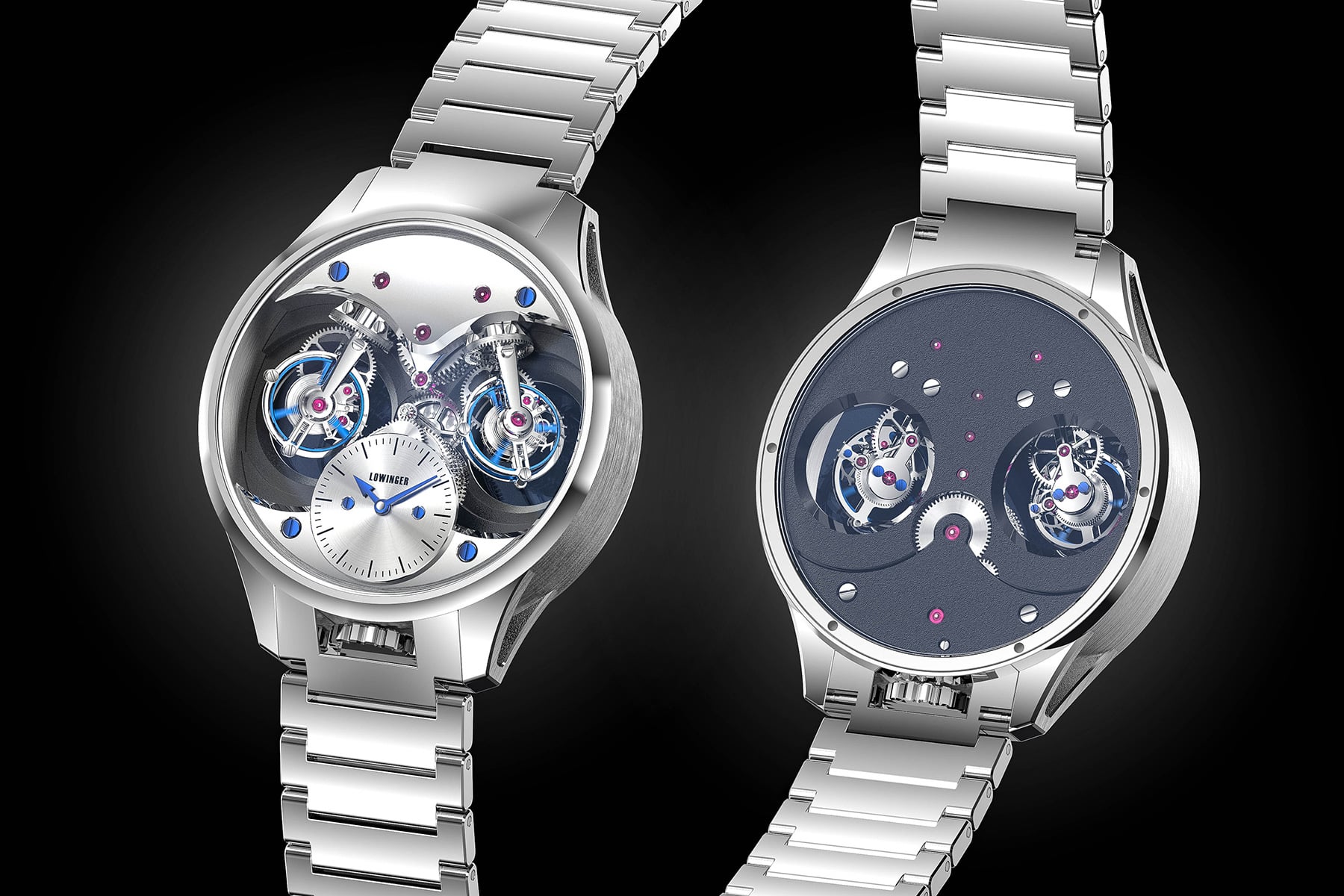
Lowinger
David Lowinger works from Chemnitz, in Saxony about 90 minutes from Glashütte, though watchmaking is not his profession by training — he is a real estate investment analyst who taught himself the entire craft from scratch, starting in 2014 with no formal schooling and no time spent at any watch company. He mastered CAD design, manual milling, lathe work, and CNC machining largely on his own, and unveiled his debut watch in 2018: a wristwatch built around a heavily reworked Unitas 6498-2, for which Lowinger machined more than 45 components himself, including the case, crown, dial, hands, and buckle, using a manual milling machine and lathe rather than CNC. The main plate, barrel, and train bridges were left as untreated German silver, hand-pearled on the front and circular-grained on the back in an almost industrial finish, paired with a DLC-coated engraved dial and mirror-polished, hand-filed syringe hands, delivered on a hand-made strap in a black walnut presentation box. Each watch consumes more than 350 hours of work, limiting Lowinger to roughly four completed pieces a year, all made to order and priced at the time around €8,500.
In 2019 Lowinger pushed further with the Series 2, a rectangular form watch with a regulator-style display powered by his own cal. DL-S2R — a hand-wound movement carrying 17 jewels and 50 hours of reserve that reuses part of the going train, regulator, and escapement from a Unitas base while substantially reworking the architecture and layout around it. Of the watch's parts, 55 are made in-house, including the bridges, winding click, and several wheels and pinions, with every Unitas-derived component refinished entirely by hand; the front-facing main plate carries a granular, hand-hammered finish requiring some 30,000 individual hammer strikes, while the boxy, deliberately hand-guided engraving on the hour and minute chapter rings gives the dial a distinctive, slightly irregular character. Cased in stainless steel at 26mm by 45mm and just 9mm high, with every case edge hand-chamfered like a movement bridge, the Series 2 launched at €18,500 with customisation options including blued steel hands, alternative movement finishing, and precious-metal cases. Lowinger's catalogue has since expanded to include the UFO, built around a modified Soprod Newton P092 automatic with an anodised titanium dial; the Digital One, an in-house regulator-complication watch that sold out; and the Blue Maze — alongside a bespoke watch design service through which Lowinger develops CAD models, movement concepts, and photorealistic renders for other aspiring or established brands looking to bring an idea to production.
Beyond his production models, Lowinger has increasingly shared more speculative, sculptural concepts that reveal the fuller range of his imagination. Among the wildest is the Tarantula, a creature-like twin-tourbillon design in a 43mm case that swells to 17mm thick to accommodate its two regulating cages: a long central body carries one tourbillon up top with a curved, domed sub-dial for the time below it, its hands bent to follow the crystal's shape, while what look like two crowns at the sides are in fact removable keys — one winds the mainspring, the other sets the time from the back of the case. Reviewers have described the Tarantula as sitting on the line between watchmaking and mechanical sculpture, drawing comparisons to MB&F's Horological Machines, alongside its stablemate the Wastelander, a more aggressive, post-apocalyptic-styled concept from the same batch of ideas. None of these concept pieces have yet reached production, but together with his four hand-built watches a year, they capture what has made Lowinger's story resonate with the wider community of independent-watchmaking enthusiasts: a self-taught engineer in provincial Saxony, working almost entirely alone, whose mechanical imagination reaches as far as anyone formally trained in the craft.