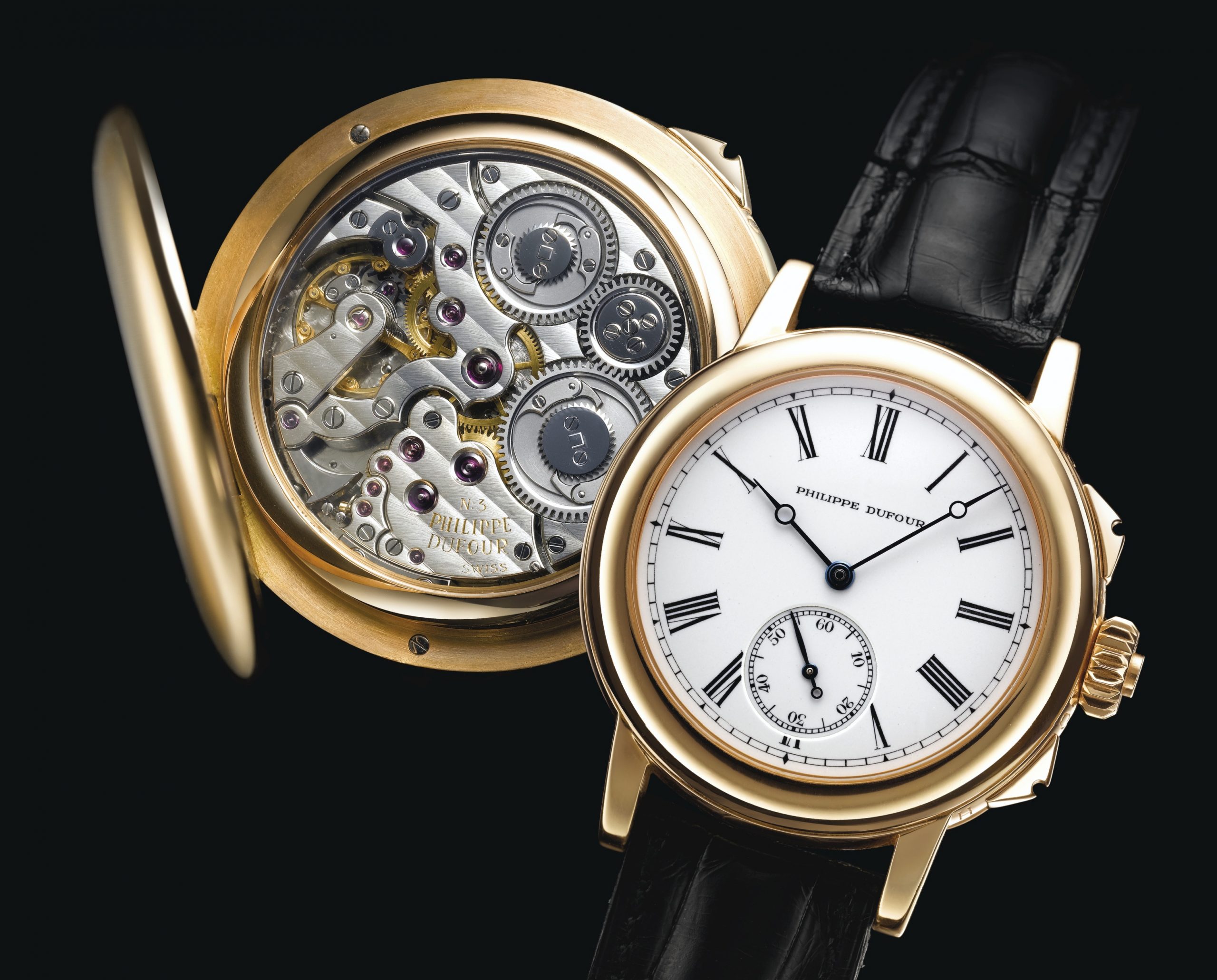
Philippe Dufour
Philippe Dufour is arguably the most revered living watchmaker — the spiritual grandfather of the modern independent movement, described by peers as the pre-eminent watchmaker of his time. Born in 1948 in Le Sentier, Vallée de Joux, he was, by his own account, no natural scholar; a technical-school aptitude test delivered the verdict that set his life's course — 'his head and hands work well, but he can be a watchmaker' — and four years later he graduated with distinction as a horloger rhabilleur. He joined Jaeger-LeCoultre in 1967 on the strength of a clause allowing him to work abroad, chasing not watchmaking but travel: a year of after-sales service in Germany, then England at the newly JLC-owned Favre-Leuba, then Swiss quartz after-sales, and finally a newspaper advertisement that took him to the Virgin Islands to run a fifty-person movement workshop, where a colleague's rebuke — 'if the lips don't work, the hands don't work either' — taught him that watchmaking was universal, not solely Swiss. Back in the Vallée, he passed through Gérald Genta and Audemars Piguet before a short, difficult stint at Comor Watch ended in a dispute with the owner; on a single day, buying that workshop, he became independent almost by accident. Restoring complicated pocket watches for five years at what would become Antiquorum — and noticing that seven in ten of the finest complications traced back to the Vallée de Joux — he built his own Grande Sonnerie pocket watch on his own time; when no investor would back it, Audemars Piguet commissioned five, over 2,000 hours of work each. When the client returned two of them badly damaged, Dufour made a vow that defined the rest of his career: never again would he work for anyone but himself.
Three creations define his oeuvre. The Grande et Petite Sonnerie (1992, 8 pieces), the world's first wristwatch grande and petite sonnerie combined with a minute repeater, was designed in secrecy and financed by an Italian patron over two and a half years, then unveiled at Baselworld 1992 to near-total anonymity — recognition arrived instead from Singapore, where ten days of meetings yielded three new commissions sealed on nothing but a handshake, convincing Dufour that Asia, not Switzerland, would be his true market. The Duality (1996, 9 pieces) revived a forgotten mechanism he discovered studying 1930s Rockford Time Museum catalogues of antique école watches: two balance wheels linked through a purpose-built differential that averages their rate errors for exceptional precision. The Simplicity (2000, roughly 200 pieces over 17 years) began as a challenge from a Philippe Dufour fan club in Tokyo, daring him to build perfection in three hands — a 30mm, 12-ligne case inspired by the robustness of 1950s–60s watches he had spent a career restoring, sold almost exclusively through a single Tokyo retailer, Shellman, where 120 of the first 200 found homes. Its creation is inseparable from Gabriel Locatelli, Dufour's first colleague at Jaeger-LeCoultre and later his workshop partner, who rejoined him specifically to build the Simplicity after retiring; Locatelli died in a car accident within months of its 2000 launch, and Dufour has said he still feels his presence in every gesture at the bench.
Today the workshop in Le Solliat is a family affair: his wife Élisabeth runs the business — it was her decision, against Dufour's own instinct, to auction Simplicity 20th Anniversary No. 00/20 at Phillips Geneva on 8 November 2020, where it sold for CHF 1,360,000, a turning point in the market's recognition of his work — and their daughter Danièla, a 2021 graduate of the Le Sentier watchmaking school, joined as a genuine watchmaker after building her own Simplicity entirely by hand as a final trial, subjected to her father's own uncompromising scrutiny before he pronounced her, at last, a watchmaker in her own right, securing the family's succession. Dufour founded the Time Aeon Foundation in 2003 to preserve hand-craftsmanship under threat from industrialization, later followed by the Philippe & Élisabeth Dufour Foundation supporting overlooked artisans more broadly. His honors span three decades: a 1992 Grimoldi gold medal for technical achievement, the 1996 Special Jury Prize of Montre Passion and Uhren Welt for the Duality, the 1998 Gaïa Prize — watchmaking's highest honor for a career devoted to timekeeping — the GPHG's own 2013 Special Jury Prize, the 2014 Tribute to Talent Prize from the Fondation de la Haute Horlogerie, the 2016 Intangible Cultural Heritage Prize, and the 2018 Revolution Awards Lifetime Achievement. His watches now anchor the auction record books: the Grande Sonnerie pocket watch at CHF 2,329,000, wristwatch Grande Sonnernies as high as CHF 7,600,000, the Duality at CHF 3,660,000, and Simplicity references reaching CHF 756,000 — figures that, as Dufour himself puts it, prove collectors still recognize meticulous craftsmanship over marketing, and the refusal to take shortcuts.