Roger Dubuis
Roger Dubuis was a legendary master watchmaker, widely considered among the founding fathers of independent watchmaking, whose Geneva craftsmanship and double-retrograde perpetual calendar made his name. In 1995 he founded the eponymous brand, making him one of the first watchmakers of the modern era to build a house under his own name. The brand that bears his name is a Geneva watch manufacture, established with the entrepreneur Carlos Dias, and it is no longer independent. Richemont took a controlling stake of about 60% in 2008, buying it from Dias, and acquired the remaining 40% in 2016 (reportedly from the investor Akram Aljord), a year before Dubuis died; today it is a wholly owned Richemont subsidiary, based in Meyrin, with David Chaumet as chief executive since 2024. It is catalogued here for the man rather than the group. Roger Dubuis spent more than two decades in the workshops of Longines and Patek Philippe, built his reputation on one of the great modern complications, and gave Geneva one of the defining independent houses of the 1990s.
Dubuis, born in 1938, was drawn to watchmaking as a boy by the clock in the belltower of his village church. The brand says he began formal training at 15 as student number 208, and that his diploma movement, the 208 calibre, earned the Poinçon de Genève. Around 1957 he joined the after-sales and repair department of Longines in Saint-Imier, where he spent about nine years working on its chronographs. In 1966 he moved to Patek Philippe in Geneva, where as a constructor and watchmaker he spent about fourteen years in the high-complications workshop, working on gongs, minute repeaters and perpetual calendars alongside Svend Andersen, according to Revolution, and leaving in 1980. He told SJX that Patek shaped his whole idea of haute horlogerie, and it left its mark on everything he later signed, from the Geneva finishing to the references to mid-century Patek and Longines chronographs in his designs.
In 1980 he opened his own atelier, restoring antique watches and clocks for collectors, auction houses and brands, and as the quartz crisis hit he helped found Le Groupement Genevois des Cabinotiers to preserve traditional horology and taught classes for young watchmakers. He also began developing his own modules. With Jean-Marc Wiederrecht, founder of the movement specialist Agenhor, and Wiederrecht's wife Catherine-Esther, he ran a small development company that the brand says was renamed P.M.E after his childhood scouting nickname, Placide. Their first module was a retrograde perpetual calendar that sat on top of a Lemania movement, made for Harry Winston, then run by Ronald Winston. In 1989 the same partnership produced the Bi-Retro Perpetual Calendar shown at Baselworld, described as the first double-retrograde perpetual calendar in a wristwatch, and the work produced several calibres and a patent for the retrograde display. Dubuis later made the bi-retrograde perpetual calendar the signature complication of his own name and named the Sympathie version as his favourite.
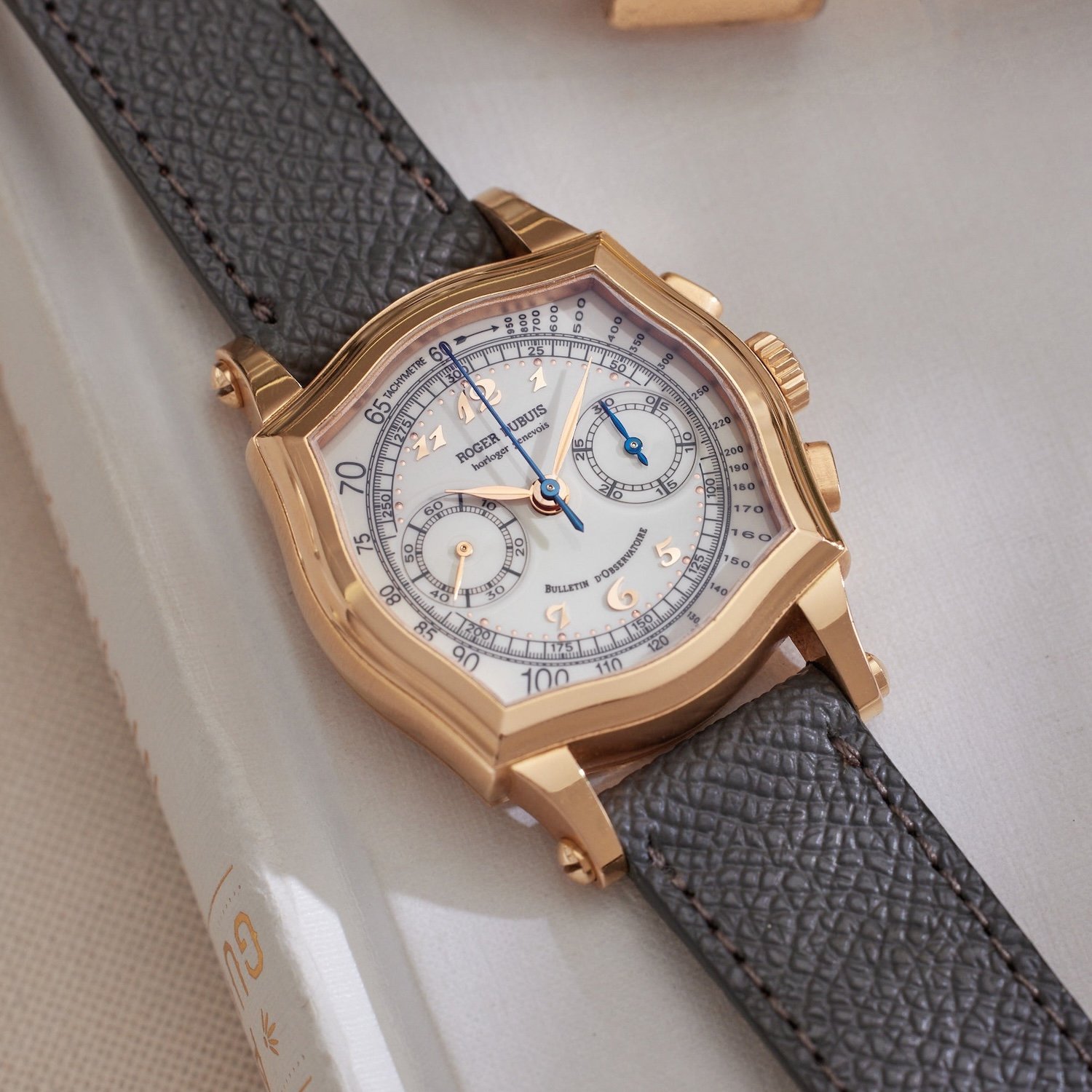
In 1995, at 57, Dubuis founded SOGEM (Société Genevoise des Montres) with Carlos Dias, a Portuguese-born businessman he had met in the early 1990s, who by one account was then working as a waiter in a Geneva café. Dias held the larger stake, with Dubuis reportedly holding about 10%. The first collections, shown from 1996, were Hommage, a tribute to the watchmakers, teachers and friends who had helped him, and Sympathie, an angular, square-cornered case with elongated lugs. Revolution's study of the early watches describes Hommage in 34, 37 and 40 mm sizes, the 40 mm the design highlight, with Breguet-numeral dials in 9 of 14 versions, and cases only in palladium, white gold, rose gold and platinum; the designs draw on Patek Philippe's references 130 and 1463 'Tasti Tondi'. Sympathie came only in 34 and 37 mm, in white or rose gold. The chronographs used the Lemania 2310 base (Dubuis calibres RD 56, and RD 65 for the monopushers), finished in Patek style with Côtes de Genève, mirror polishing and anglage; a 40 mm monopusher with a different calibre was limited to 19. Every watch carried the Poinçon de Genève and was certified at the Besançon Observatory, with the viper stamp for a rate between -4 and +6 seconds. Most variants were capped at 28 pieces: Dubuis reportedly planned 26, Dias pushed for 28 (partly for Asian markets), and the number may also echo Dubuis's student number 208. The brand ties the first series of 28 to a visit by the Sultan of Brunei, which led to its first bespoke order and later the Rarities service. The earliest known Hommage chronograph has paperwork stamped 22 November 1996. A Collected Man argues that these early pieces, more than the later models, reflect the man himself.
The company was renamed Manufacture Roger Dubuis in 1999, the year of its first in-house movements, filed a first patent in 2000 for a tri-retrograde display, built its own manufacture in Meyrin in 2001, introduced its first in-house tourbillon in 2003, and under Dias grew into a flamboyant, fully in-house house: about 28 calibres by 2006, the Excalibur collection and an RD01SQ double flying tourbillon in 2005, roughly 450 employees, about 25,000 watches a year and revenue above CHF 100 million at its peak. Dubuis retired from day-to-day involvement around 2003. Heavy investment in in-house manufacture left the company in debt, and when the 2008 downturn arrived, Dias sold his 60% to Richemont, reportedly for about CHF 150 million, and left. Richemont restructured the business, scrapped many of the movements, and shrank output to a reported 5,000 or so watches a year. Dubuis returned in 2011 as a brand ambassador and, according to Time Transformed's tribute, said when asked about regrets that he had only one: selling his name. He died on 14 October 2017.
Roger Dubuis today calls its approach Hyper Horology, combining Geneva haute horlogerie with theatrical design, and says about 92% of its pieces carry the Poinçon de Genève. For its 30th anniversary in 2025 it revived the founder's signature complication in the Hommage La Placide, a 38 mm pink-gold bi-retrograde perpetual calendar limited to 28 pieces at CHF 115,000, built on refurbished new-old-stock RD14 movements from 2004 with remade RD72 calendar modules. Dubuis also contributed to the Maîtres du Temps collaborations, Chapter One in 2008 with Christophe Claret and Peter Speake-Marin, and Chapter Two in 2009 with Daniel Roth and Speake-Marin. The watches made before Richemont's 2008 arrival, especially the first gold Hommage and Sympathie series made while Dubuis was still at the bench, are not the same thing as the current production, and this listing gives the present ownership while keeping its focus on the founder.