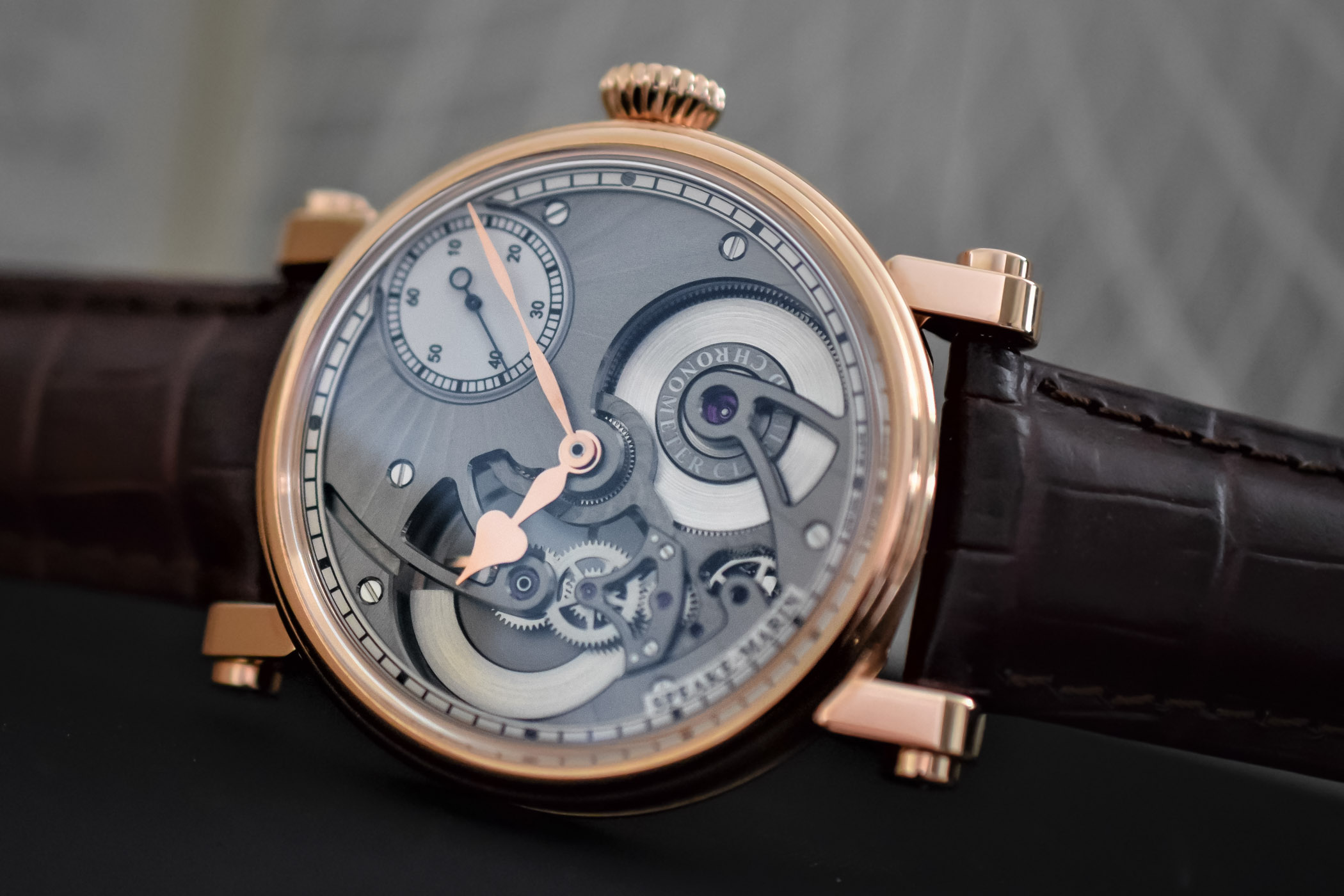
Speake-Marin
Speake-Marin was founded in Geneva in 2002 by a London-based watchmaker (Peter Speake, who departed the company in 2017 and later founded the separate venture PS Horology) and has, since 2012, been owned and led by entrepreneur Christelle Rosnoblet as CEO. Rosnoblet began investing in 2014 in Le Cercle des Horlogers, the fine-watchmaking atelier in the Neuchâtel region where every Speake-Marin movement is developed, assembled, and controlled, becoming a shareholder in 2020; that stake gave the house full independence over its own movement sourcing, quality standards, and creative execution. A separate creation studio in Geneva works alongside Le Cercle des Horlogers on every dial, case, and movement. Speake-Marin describes its mission as creating 'Belle Horlogerie' — beautiful watchmaking rooted in Swiss fine-watchmaking heritage — with every collection produced in limited editions only, built exclusively around in-house or otherwise exceptional movements, and designed to be found nowhere but under the Speake-Marin name.
The house's design DNA traces back to its very first watch: the Foundation, a hand-crafted tourbillon pocket watch whose distinctive hand shapes and tool-motif tourbillon cage still recur across the modern collection. That identity crystallised in the Piccadilly case — a slim, circular silhouette balanced against robust lugs, with a small-seconds counter set distinctively between 1 and 2 o'clock — which has anchored the brand's watchmaking reputation for over two decades. In 2021 the house introduced a second signature form, the 'La City' case, named for London's financial district and built around a square nested within a circle (or a circle within a square, depending on the angle), giving the collection a more contemporary architectural edge. Four collections carry that language forward today: Ripples, built around the house's skeletonised automatic movements; Piccadilly, the brand's more casual-chic register; Haute Horlogerie, home to its minute repeaters and double tourbillons; and the Art Series. Speake-Marin notes that some forty distinct skills go into producing a single timepiece in its workshop, from initial design through movement development, decoration, assembly, and casing.
That in-house capability shows most clearly in the SMA movement family developed at Le Cercle des Horlogers. The Openworked SMA01 and SMA01-3 established the house's One&Two visual signature — a micro-rotor flush with the bridges and a small-seconds counter at 1:30 forming a deliberate triangulation with the barrel and oscillating mass — while the SMA02 added a dual-time display with retrograde date. The closed-dial SMA03 family (including the 'Tradition'-finished SMA03-T, the 20th-anniversary SMA03-T20, and the big-date SMA03-TD) brought rhodium plating and hand-polished inner angles to the same architecture. The SMA05-1 and SMA05-2 introduced a flying tourbillon at 1:30 — a position the house says has never been used by any other watchmaker, chosen deliberately despite the added complexity of routing the tourbillon cage through the time-setting module — paired with a 72-hour power-reserve display at 7:30. Haute Horlogerie honours include the SMA-HH02, combining a 60-second flying tourbillon with a minute repeater carillon, and the SMA-HH06, whose vertically stacked double tourbillon shares a Speake-Marin-patented rate equaliser between the two cages. In 2024 the ultra-thin SMA07 — just 3.25mm, with an integrated micro-rotor beating at 5Hz (36,000vph) for improved chronometric accuracy — powered the Ripples Skeleton, and the newest SMA06 anchors the 2026 Ripples Kármán Line, its tungsten micro-rotor finished in an exclusive pattern of alternating rhodium-plated and blue-PVD rectangles beneath a sapphire dial with blue metallisation, in the La City case at CHF 33,900.