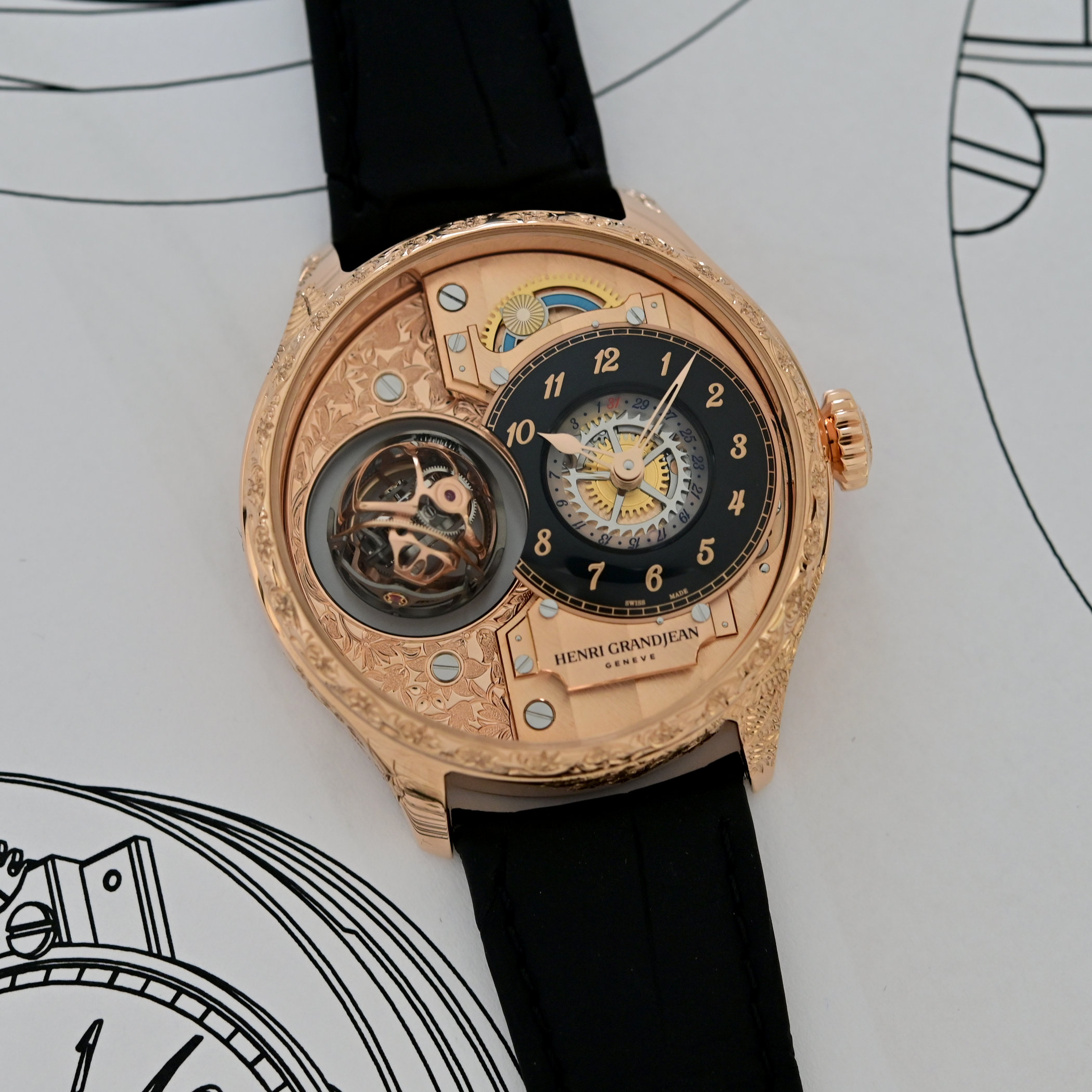
Henri Grandjean & Cie
The Grandjean name traces back to 1792, when David-Henri Grandjean established his first workshop in La Chaux-de-Fonds before relocating to Le Locle, then the heart of Swiss watchmaking. From the outset the family pursued mastery without division of labour, exploring automata and so-called 'magician' mechanisms prized not for trickery but for their precision — in 1842 a magician watch by David-Henri Grandjean was presented to King Frederick William IV of Prussia. His sons Henri and David-Henri turned the family's attention to marine chronometry, completing their first chronometer in 1832, sold in Lima, as the Grandjeans built a retail presence stretching to Rio de Janeiro and Lima and earned distinctions at the 1851 Great Exhibition in London; Henri Grandjean was also among the industrial backers of the Neuchâtel Cantonal Observatory, founded in 1858. In 1854 Henri Grandjean formally founded Henri Grandjean & Cie with partners including his nephew (also named Henri) and Auguste Rossel, and by 1858–60 the house's French and English catalogues listed more than sixty calibres, including chronometers and complicated chronographs. On Henri's death in 1878 the company passed to his niece Oline Rossel, was renamed Rossel & Fils in 1892, reorganized in 1912 as Société Anonyme de la Fabrique des Montres Henry Grandjean & Cie, and in 1926 was acquired by Paul Cattin, the founder of Oris. A family branch continued from 1973 as Grandjean & Cie, specializing in watch cases and engraving. Today's Henri Grandjean & Cie presents itself not as a revival but as a continuation of that two-century lineage, now based in Noiraigue in the canton of Neuchâtel.
The modern manufacture is built around a single watch family, The Magician — a deliberate echo of the historic magician mechanisms that first made the Grandjean name — offered in nine distinct expressions, each sharing one in-house calibre and 45mm case architecture but distinguished by material and finish. The Carved series pairs rose gold or white gold with black onyx or aventurine in deeply sculpted cases; the Geneva series spans rose gold, rose gold with black onyx, titanium with aventurine, and a gem-set white gold execution; Patiala is a hand-engraved, narrative dial inspired by the Indian princely state's watchmaking patronage; and the Atrivm pair are cased entirely in blue or white sapphire crystal, turning the case itself into an architectural study in transparency. Dial materials throughout include 5N 18K rose gold, black onyx, natural aventurine, and gem-setting, each requiring its own specialist finishing technique.
Every example is powered by the same hand-wound, entirely in-house Mysterious Triple-Axis Tourbillon calibre: 218 components, twin barrels driving a 21,600 vph (3Hz) escapement for an approximate 42-hour power reserve, with three concentric tourbillon cages rotating simultaneously at 10, 18, and 60 seconds to compensate for gravitational error from every angle, visible through sapphire crystals on both dial and caseback. The movement is conceived and developed from a blank sheet rather than adapted from an existing base, with plates and bridges finished by hand in traditional Geneva stripes and hand-polished bevels; assembling the triple-axis tourbillon alone demands tolerances invisible to the naked eye, with a single adjustment sometimes taking hours and full assembly spanning days. Each finished movement is hand-engraved with a signature bridge reading 'Henri Grandjean, Genève' before undergoing multi-position rate testing, power-reserve verification, and water-resistance and function checks. The collection is presented by appointment only at the brand's Geneva showroom.