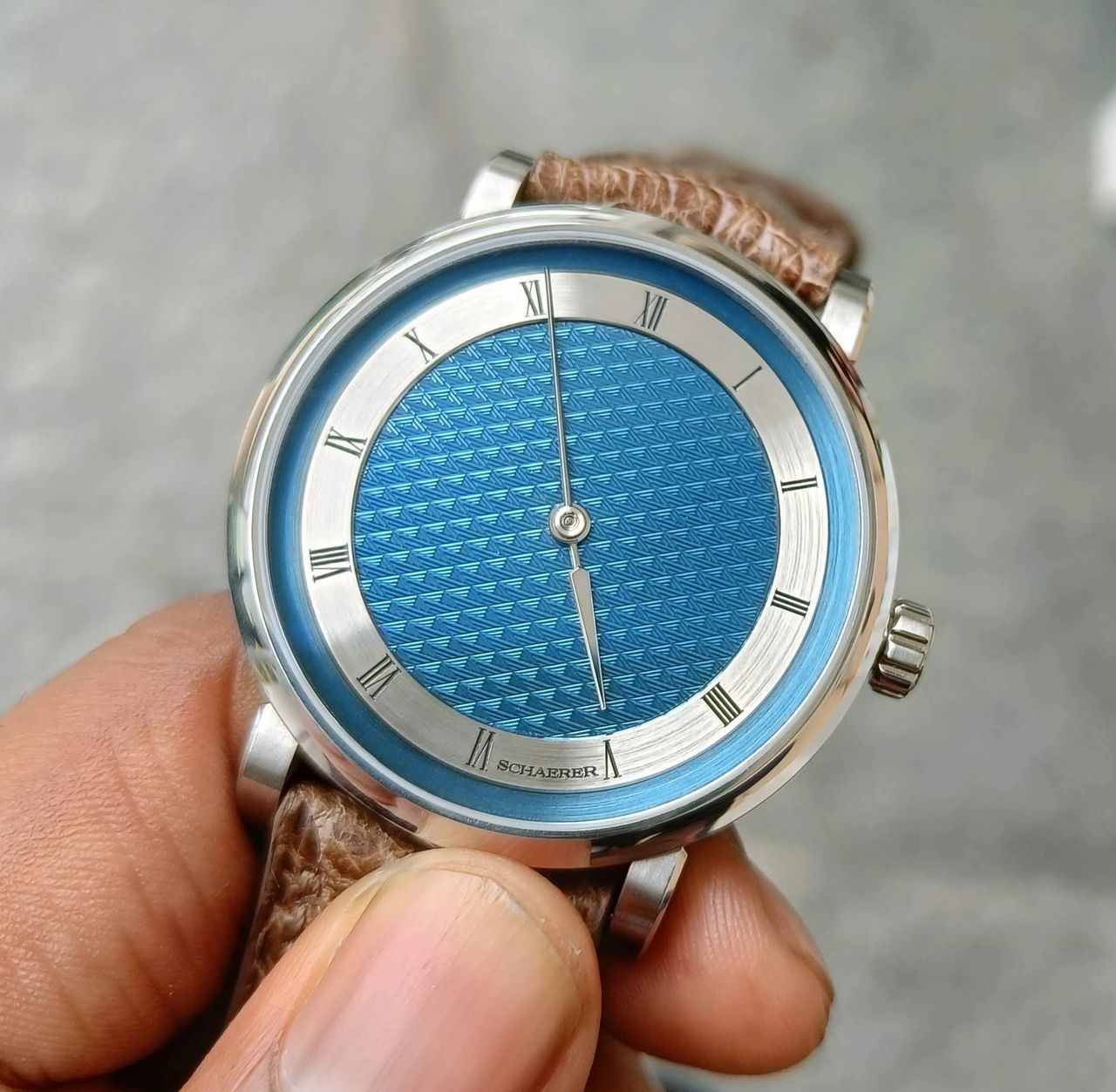
Schaerer
Schaerer Watches is the independent debut of Stefan Schaerer — a Swiss watchmaker whose journey to his first watch is one of the most comprehensive acts of individual craftsmanship recorded in contemporary independent horology. The brand takes his last name and the watch was unveiled to the world for the first time on the Swiss Watch Gang YouTube channel in 2025, after years of anticipation from the followers of his Instagram account @sketch_to_watch — an account that had been documenting his creative process since 2016 without ever revealing the watch's name or showing the finished piece in full. The mystery was intentional: Schaerer wanted to show the process of making a watch from scratch, component by component, without the commercial framing of a brand. After four years of a traditional Swiss watchmaking apprenticeship, he worked in the watch industry in mass production — across watch head assembly, quality control, and then product development — before a desire to return to working with his hands drove him back to the bench. He began designing a watch in his free time, bought machines, discovered that you need a great many machines to do what he had in mind, and found himself with a tools collection as a new hobby. He tried several designs, failed, refined, and in 2018 formally started the project that became the first Schaerer watch. It took seven years.
The governing philosophy of the first Schaerer watch was absolute: to make every component himself, to verify that he could do every part independently, and to choose a time-only watch as the vehicle precisely because its simplicity would expose rather than hide the quality of every individual element. The case — 39.5mm × 8.2mm — is made completely in-house, including the unusual construction of the middle part, the lugs, and the caseback. The lugs are produced as separate components that fit into holes in the middle case — a construction that allows access to every hidden angle during finishing, and provides the flexibility to adjust proportions that a one-piece case would not permit. The dial is made entirely in-house, including the guilloché — Schaerer built his own guilloché machine after finding it nearly impossible to source one or to find reliable information on how to make one, so he designed and built it himself. The dial's hour markers are individually hand-engraved and filled with lacquer. The hands are made in-house. The only elements outsourced are the dial coating (a specialist chemical process) and the raw mainspring and hairspring, which are sourced from old stock. Three jewels are produced in-house; the remainder are purchased.
The movement is where the depth of the project is most visible. Its architecture is classical — the layout of bridges and wheels drawn from the vocabulary of Swiss movements of the 1950s and 1960s — but every component is made by Schaerer himself, using an extensive array of machines including a Geneva Stripes finishing machine he built himself. The bridge finishing is flat Geneva Stripes — not the stepped variety, deliberately chosen for their subtlety — applied with a wooden tool. The intermediate wheel and the steel balance wheel bridge are mirror polished, a demanding feat on large components. Interior angles appear on the steel bridge. Perlage is applied to the lower plate. The balance wheel itself is of a distinctive custom shape, carrying four regulating weights machined from 18-karat gold — chosen not as decoration but for a practical reason: the gear wheels are made from 14-karat gold, since gold is the only material soft enough to be mirror-polished without risking irreparable scratching; if a brass or steel wheel is scratched during polishing, it cannot be repolished without dimensional change, whereas gold can be worked repeatedly. The power reserve is approximately 39 hours (marketed as at least 38 hours); the watch is manually wound. The first series is limited to 12 pieces at CHF 35,000, with some still available with a production timeline of late 2025. Complications are already in Stefan's mind for the future — not yet on paper, but described as something technical — and he has indicated he may use the same movement again with different dial configurations before moving to a new calibre.