Verbin
Mikhail Verbin was born on December 4, 1981, in the Soviet Union, to a modest family — his mother a schoolteacher, his father Sergei a mechanic at a factory attached to a scientific institute. The 1990s were difficult after the Soviet collapse, with his father retraining in construction, but Mikhail continued his studies and developed an early fascination with watches through his father's own — a gold Longines, followed by Mikhail's first watch, a steel Casio. He went on to earn a teaching degree and then a construction degree, and around 2001 his father conceived an original watch-jewel design; Mikhail, already skilled in 3ds Max, modelled it, and his father found a jewellery workshop to produce it — a simple ETA 2824-2-based watch in an elegant gold case that Mikhail recalls as a genuine challenge to bring to life.
After his studies, Mikhail worked briefly in a school and then on a construction site, rising from team leader to site manager; with his first real salary he bought his own dream watch, a Breitling Superocean Steelfish X-Plus 2000m, before deciding his future lay elsewhere. Between 2010 and 2011, he and his father began planning a small watch workshop of their own — Sergei bringing his machining skills, Mikhail his CAD design ability in SolidWorks and AutoCAD — gradually acquiring equipment while Mikhail taught himself watchmaking from Soviet-era literature, disassembling and reviving old broken calibres as his father taught him the lathe and milling machine. In 2012 he met the artist Darina Potapova, whose aesthetic sense — colour, symmetry in nature, form — would go on to shape his design instincts.
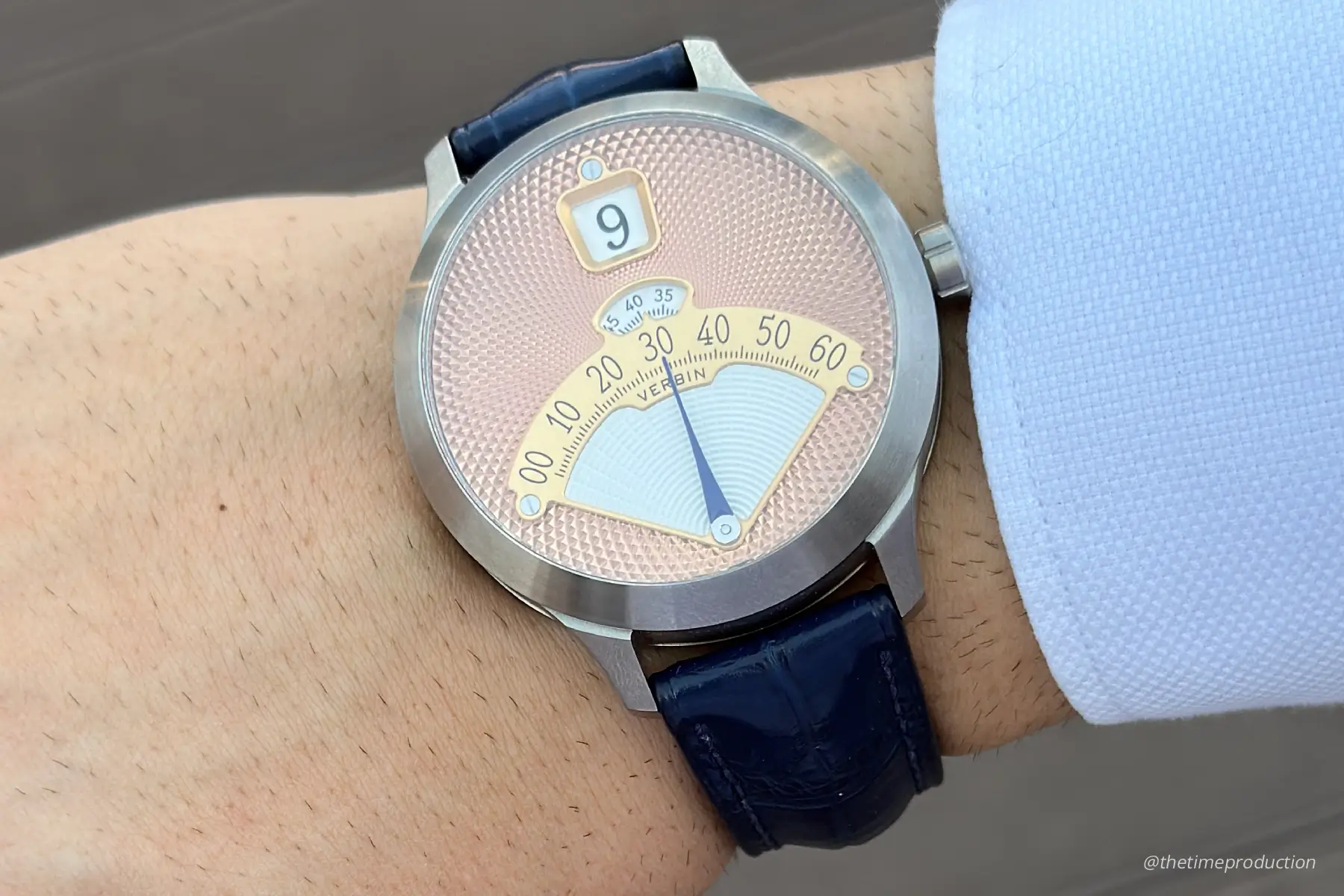
In 2014, working from a reliable Swiss ETA 2824-2 base since they lacked the equipment for anything more ambitious, father and son settled on the idea that would define their first watch: a jumping-hour display paired with 100-degree retrograde minutes. A first prototype followed in 2015, but fell short of the reliability and finish they wanted — and without access to a high-precision CNC mill capable of the tolerances the design demanded, they took the extraordinary step of designing and building their own machine tool from scratch, with Mikhail teaching himself machine design specifically for the purpose. Nearly a decade of iteration, adjustment, and remachining followed before the final prototype of the Sonare Retro was completed in 2021 — its name drawn from the Latin sonare, to sound, and retro for its retrograde display, chosen because the module's mainplate and titanium case were engineered specifically to give the jumping-hour mechanism a clear, faintly resonant, deliberately audible click at the change of every hour.
The production Sonare Retro is cased in fully brushed titanium at 42.5mm across, 12.5mm thick, and 49mm lug-to-lug, water-resistant to 5 ATM with sapphire front and back. Its two-tone guilloché dial, offered in salmon or cream-white, sets a jumping-hour aperture and running-seconds aperture around a curved retrograde-minute sector at 35.8mm visible diameter. Inside is the VR.100, an automatic movement built on a modified ETA 2824-2 or Sellita SW200-1 base fitted with an in-house jumping-hour and retrograde-minute module, running at 28,800vph with roughly 38 hours of reserve; a purpose-built locking system holds the hour disc firmly through a spring-loaded position lever and a twelve-toothed star wheel, driven by a spiral cam that completes one rotation per hour and releases the display in a clean 30-degree jump. The first edition of eight pieces, on dark blue alligator leather with a titanium pin buckle, started at 10,000 USD and sold out; Verbin targets around ten watches a year, prioritising, in his words, sincere and honest watchmaking over scale. A sport-oriented variant on the same titanium case and VR.100 base, with a 1960s-motorsport-inspired dial and a jumping-hour, retrograde-seconds display in place of the original's retrograde minutes, remains at the prototype stage, shown through the Perpétuel Gallery in Dubai's DIFC.