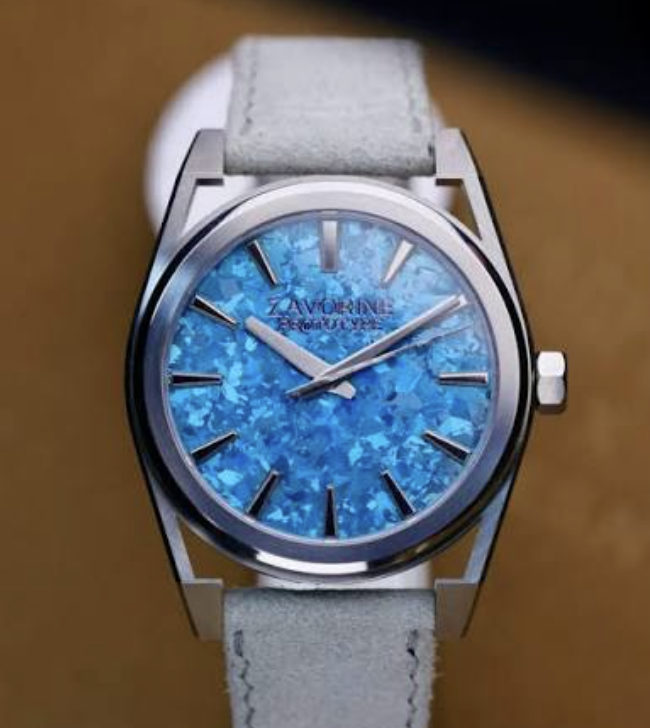
Zavorine Watchmaking is an independent, USA-based watchmaking operation built around a single flagship creation: the Zavorine Vega, a luxury titanium sports watch distinguished by an in-house micro-rotor movement of Zavorine's own design and construction. A micro-rotor is a small, dense metal winding weight set flush within the plane of the movement itself, rather than sitting on top of it as a conventional oscillating rotor does — a construction choice that allows the entire watch to be built significantly thinner than a standard automatic, at the cost of the far greater engineering difficulty of fitting a functional winding mechanism into that reduced space. Micro-rotor construction has historically been reserved for only a small number of high-end manufactures — Patek Philippe, Piaget, Vacheron Constantin, Bulgari, and a handful of independents among them — making Zavorine's pursuit of the format as a solo or small-scale operation a genuinely ambitious technical undertaking.
The Vega's case is machined from Grade 5 titanium, an aerospace-grade alloy prized for its exceptional strength-to-weight ratio, corrosion resistance, and comfort on the wrist relative to steel of equivalent durability. Zavorine's process, documented across a series of workshop videos, involves precision CNC machining of both case and gear-train components directly from solid blocks of aerospace-grade metal — cutting away material to reveal the finished part rather than casting or stamping it, a slower and more exacting approach that gives the watchmaker complete control over tolerances and finish at every stage. The in-house calibre pairs its micro-rotor winding system with a free-sprung balance — a regulating balance wheel adjusted for rate via small weights integrated directly into the balance rim itself, rather than through a separate regulator lever, a construction associated with more consistent long-term accuracy and considered a hallmark of higher-end watchmaking. Visually, the Vega pursues a sleek, sharply angled sports aesthetic: a case defined by crisp geometric facets, hollow-worked lugs that lighten the silhouette and add visual complexity where the case meets the strap, and dials available in customised, crystallised finishes that give each example its own distinct light-catching texture. As a small, hands-on operation producing hand-finished, in-house movements in very limited numbers, Zavorine Watchmaking represents the kind of ground-floor independent watchmaking that is often documented as much through direct workshop footage and social media as through traditional retail or press channels.
The micro-rotor's history explains why Zavorine's ambition is worth taking seriously. The winding system traces back to a 1958 press conference at Geneva's Hotel des Bergues, where Universal Genève and Büren jointly unveiled competing versions of the technology after developing it independently and unaware of one another; Büren went on to license the design to IWC, Hamilton, Bulova, Baume & Mercier, and Breitling, while Piaget used it the following year to build the 2.3mm calibre 12P, the thinnest automatic movement in the world for two decades. Patek Philippe's calibre 240 of 1977 later cemented the micro-rotor's reputation as a mark of serious manufacture-level engineering, and today the format remains the preserve of a short list of manufactures — Patek Philippe, Piaget, Vacheron Constantin, Bulgari, Chopard, and Vaucher among the Swiss houses, joined by only a handful of independents such as Laurent Ferrier and Romain Gauthier. Building a functional micro-rotor calibre from a solo or small-team operation, rather than licensing an existing supplier movement, places Zavorine in genuinely rare company; the physical constraint every micro-rotor design must solve — reconciling a winding weight a fraction the size of a conventional rotor with the winding efficiency of one four times larger — is a problem the watchmaking industry has spent nearly seventy years refining and still has not fully resolved. Public documentation of Zavorine's own operation remains limited largely to workshop video and social media rather than press coverage, but that scarcity of column inches says nothing about the difficulty of what the Vega is attempting to achieve on the bench.