URWERK
URWERK was born at a student party in December 1995, when Felix Baumgartner, his brother Thomas, and Martin Frei spent an evening over beers and rock music discussing their philosophies on time. On January 1st 1996, the idea was born. Felix — born in Schaffhausen into a watchmaking family, whose first word was 'tick-tock' — earned his watchmaking diploma in Solothurn in 1995 after learning restoration in his father's atelier, where clocks of immense historical significance were serviced. Martin — born in Winterthur, son of a research engineer — earned his Graphic Design diploma from the School of Visual Arts Zurich in 1989 and studied under renowned Swiss artist Roman Signer.
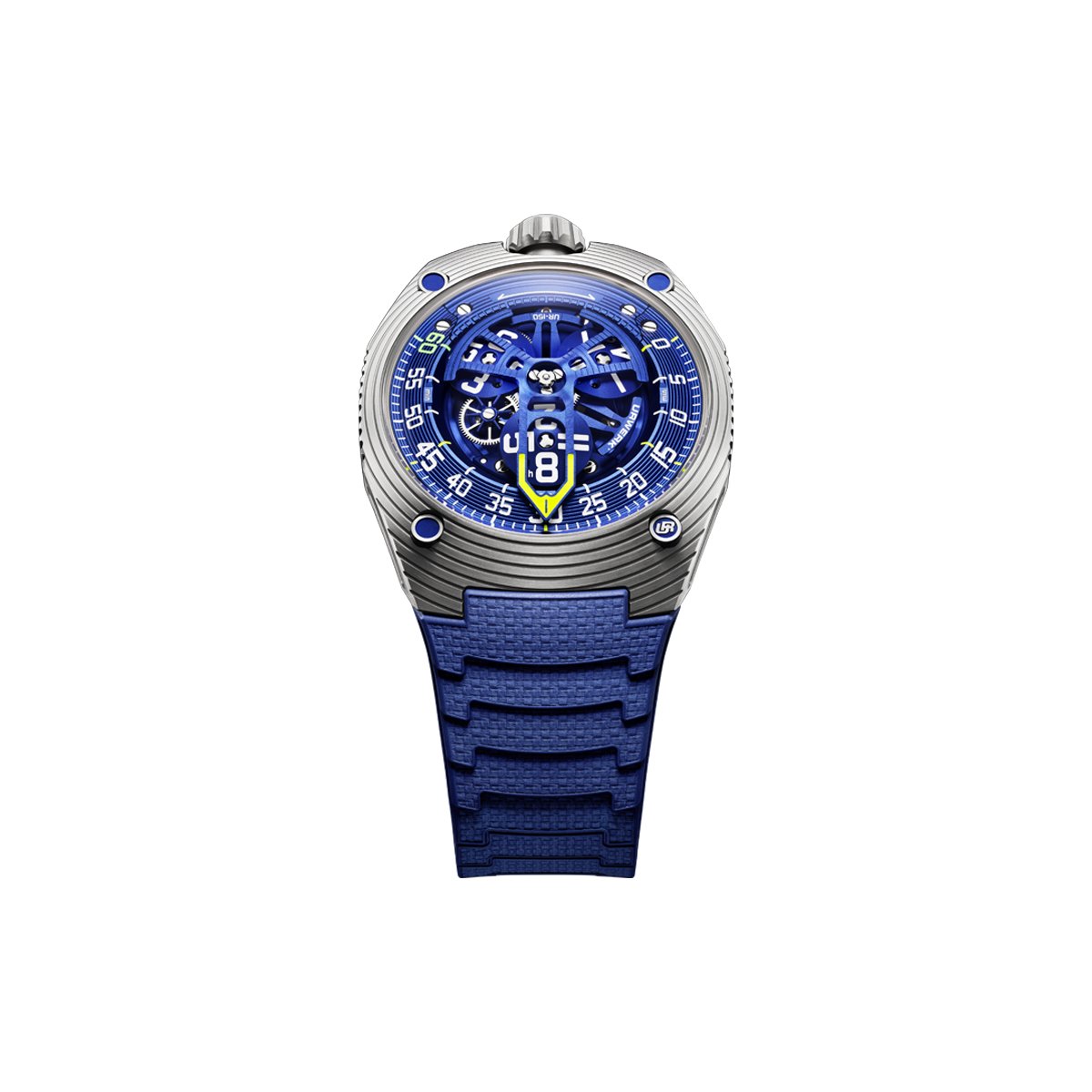
The brand was officially founded in 1997 and first presented at AHCI that year with its debut wandering-hours model. 'We began essentially as a core group of artists who wanted to interpret time differently.' The name: 'UR' refers both to the ancient Mesopotamian city of Ur of the Chaldees — where Sumerians first established units of time 6,000 years ago — and to the German word for 'primeval' or 'original'; 'WERK' means mechanism or creation. Together: Original Movement. Key milestones: UR-101/102 (Baselworld 1997, first wandering hour models); UR-103 (2003, three-dimensional cone-shaped satellites); Opus 5 with Harry Winston (2005); UR-202 with turbine winding (2008); UR-CC1 'King Cobra' (2009, 13 years of development); UR-1001 Zeit Device with 1,000-year indication (2011); EMC (2013, first high-end mechanical watch with electronic precision monitoring); AMC atomic master-slave clock system (2017); UR-112 Aggregat with fully digital display (2021); UR-230 'Eagle' with dual shock-absorbing turbines (2023); UR-150 Scorpion with retrograde flying carousel (2024). Four current collection lines: UR-Satellite, UR-Chronometry, UR-Special Projects, and UR-Legends.
Before founding URWERK at just nineteen, Felix Baumgartner spent formative years in the Sainte-Croix valley, working in the ateliers of automaton-maker François Junod and fellow radical independent Vianney Halter — an apprenticeship in avant-garde mechanics that shaped everything that followed. Recent years have pushed the house's cosmic obsessions to their logical extreme: the 2025 UR-10 SpaceMeter abandons the satellite hour display entirely for a set of subdials tracking the Earth's actual motion through space — one counter for every 10 km of the planet's daily rotation, another for every 1,000 km of its solar orbit, a third combining both scales — with Martin Frei explaining the piece as a reminder that 'time is not something we observe, it is something we inhabit'; a final 25-piece Blue edition closed out the model's run in 2026. That same year brought one of URWERK's most unexpected collaborations yet: UR-FREAK, a joint project with fellow Geneva radical Ulysse Nardin fusing two of independent watchmaking's most iconoclastic design languages into a single watch. Producing around 150 to 200 pieces annually and still led by the same two friends who dreamed it up over beers in 1995, URWERK continues to treat every new release less as a model update than as a fresh thesis on what a watch is even for.